.jpg)
Does your anxiety feel less like a moment and more like a constant background state?
Anxiety does not always arrive in obvious ways. It often builds quietly in the background of daily life. You notice it in overthinking small decisions, replaying conversations, or feeling a constant sense of urgency that has no clear source. Over time, it stops feeling like a reaction and starts feeling like the normal way your mind works.
For many people, this is where CBT for anxiety becomes relevant. Not as a concept, but as a way to understand what is actually happening inside those thought loops and physical reactions. Anxiety isn't limited to mere emotional discomfort. It is a pattern between thoughts, body responses, and behavior that keeps reinforcing itself.
This is where CBT techniques for anxiety come in. They focus on how thoughts are formed, how they escalate, and how they can be interrupted in real situations, not just understood in theory. Through simple, structured shifts, it becomes possible to change how anxiety shows up in everyday life, rather than constantly trying to manage its intensity after it takes over.
Is Your Anxiety Affecting Your Everyday Life?
What feels like “normal stress” at first can slowly start influencing how you think, speak, and respond to day-to-day situations.
You might find yourself second-guessing simple choices or replaying interactions long after they are over. Some people notice physical signs first, like tightness in the chest, restlessness, or difficulty focusing on one task without drifting into worry.
This is where understanding CBT for anxiety becomes useful as a way to notice what keeps repeating in your responses.
How anxiety tends to show up in real life
- Overthinking small decisions: Ordinary choices start feeling loaded with unnecessary pressure
- Mental replay loops: Conversations or events repeat in your mind long after they end
- Physical restlessness: The body stays tense even when the situation is calm
- Difficulty staying present: Attention keeps shifting toward “what could go wrong” thinking
- Emotional fatigue: Everyday tasks start feeling heavier than they should
These patterns are often linked to underlying anxiety management techniques that haven’t yet been learned or applied in an organized way. Without awareness, the cycle continues quietly in the background of daily functioning.
So how to manage anxiety in daily life?
The answer lies in a patient thought-work technique.
What is Cognitive Behavioral Therapy (CBT) and Why is it Effective for Anxiety?
Anxiety often feels fast. A thought appears, and your body reacts before you even have time to question it. That reaction then feeds the next thought, and the cycle continues without much pause.
This is where Cognitive Behavioral Therapy for anxiety becomes relevant. It focuses on what is happening inside that cycle. Not in a theoretical way, but in the actual moment it unfolds. Thoughts, emotions, and behavior are not treated as separate experiences. They are seen as one loop that keeps repeating in predictable ways.
With CBT techniques for anxiety, the attention shifts to what happens between the thought and the reaction. That small gap is usually where anxiety either builds or begins to settle.
What starts to change when this becomes clearer:
- A thought feels less like a fact and more like an event passing through your mind
- Emotional reactions feel linked to triggers instead of random
- The urge to react immediately becomes slightly easier to notice
- Certain situations stop feeling “new” and start feeling familiar in pattern
- You begin to see where your responses are learned, not fixed
This is how CBT for anxiety starts to work in real life. Not by removing anxiety completely, but by making the process behind it visible enough that it no longer feels automatic all the time.
Read Next: What Happens When You Stay Stuck Too Long Without Support
5 CBT Techniques for Anxiety That Work in Real-Life Situations
Anxiety does not respond well to vague advice in the moment. It shows up during real situations like conversations, deadlines, decisions, and uncertainty. These CBT-based techniques focus on what you can actually do while anxiety is happening, not after it has already passed.
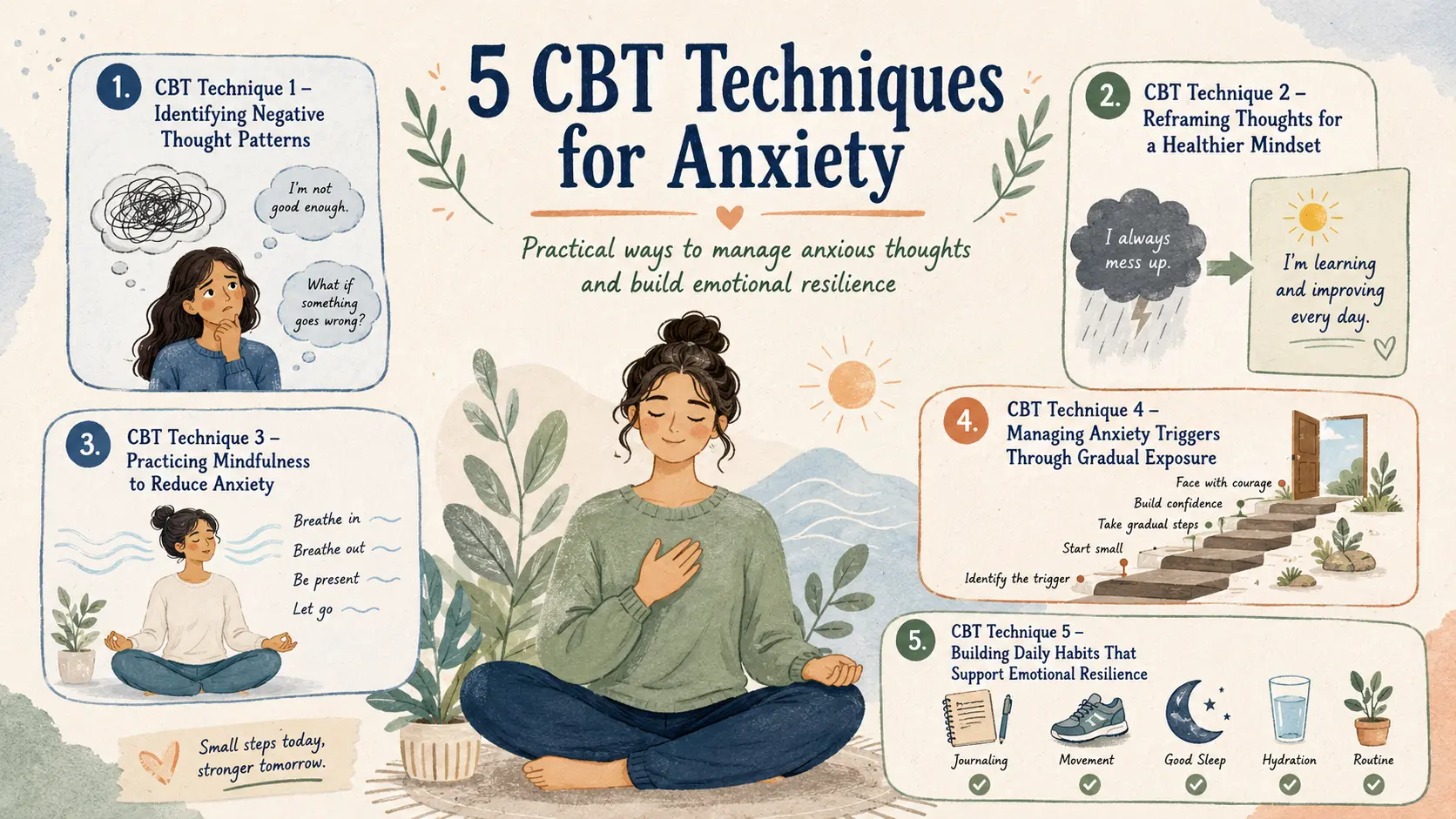
CBT Technique 1: Identifying Negative Thought Patterns
An anxious moment usually starts with a thought that feels immediate and believable. It can sound like “this will go wrong,” “I can’t handle this,” or “something is off.” These thoughts often appear so quickly that they feel like facts instead of interpretations.
Identifying thought patterns involves slowing down enough to notice the exact wording in your mind. The tone of the thought matters. So does how often it repeats in similar situations.
Over time, certain patterns become visible:
- Predicting outcomes before anything happens
- Assuming negative intent in neutral situations
- Treating uncertainty as danger
- Replaying past mistakes during present tasks
Once these patterns are visible, anxiety starts to feel less random and more structured.
CBT Technique 2: Reframing Thoughts for a Healthier Mindset
Reframing works at the point where anxiety begins to build meaning around a situation. A single thought can escalate emotional intensity depending on how it is interpreted.
In Cognitive Behavioral Therapy for anxiety, reframing introduces an alternative interpretation that stays closer to observable reality. The situation remains the same, but the conclusion attached to it becomes less absolute.
Internal shifts often look like this:
- “This will go badly” shifts into “I don’t have enough information yet”
- “I can’t handle this” shifts into “This feels uncomfortable right now”
- “Something is wrong” shifts into “I am noticing uncertainty”
Repeated use of reframing reduces how quickly anxiety escalates. The mind stops locking onto the first interpretation as the only possible outcome.
CBT Technique 3: Practicing Mindfulness to Reduce Anxiety
Anxiety often pulls attention away from the present and places it in imagined outcomes or past events. The body stays in the current moment, but attention moves elsewhere.
Mindfulness interrupts that shift by returning focus to immediate experience. This is a core part of many anxiety management techniques used in CBT-based work.
Attention is redirected toward:
- Physical sensations like posture or breath
- Environmental sounds without interpretation
- Simple sensory details in the present moment
Thoughts continue to appear, but they begin to lose dominance when attention is not fully absorbed by them. Over time, this reduces how strongly anxiety takes control of attention.
CBT Technique 4: Managing Anxiety Triggers Through Gradual Exposure
Avoidance changes how the mind assigns meaning to situations. When something is avoided repeatedly, it becomes mentally larger than it actually is.
Gradual exposure shifts this pattern through controlled and repeated contact with avoided experiences. Each step of this gentle mindset reset stays manageable enough to prevent overwhelm, while still engaging with the trigger.
In practice, this may involve:
- Entering mildly uncomfortable situations for short durations
- Breaking a single avoided task into smaller interactions
- Repeating exposure until emotional intensity begins to reduce
With repetition, the nervous system stops treating these situations as immediate threats. Predictability replaces avoidance-based amplification.
CBT Technique 5: Building Daily Habits That Support Emotional Resilience
Anxiety does not only come from thoughts. It builds from accumulated daily strain, irregular routines, and lack of recovery time.
CBT techniques for anxiety often extend into daily structure because emotional stability depends on how the system is maintained over time.
Patterns that influence anxiety levels include:
- Irregular sleep cycles that disrupt emotional regulation
- Continuous stimulation without recovery gaps
- High decision load without structured pauses
- Lack of predictable daily rhythm
Stabilizing these areas reduces background tension. As baseline stress lowers, anxiety reactions become less frequent and less intense, which in turn makes other CBT strategies easier to apply in real situations.
Read Next: Insomnia Tips That Actually Work: How to Fix Your Sleep When Your Mind Won't Shut Off
When Should You Seek Professional Support for Anxiety?

There is a point where anxiety stops feeling like background noise and starts shaping how daily life unfolds. It shows up in hesitation before simple decisions, tension that does not fully settle, or a mind that keeps running even when nothing is happening externally.
Sometimes the shift is subtle. You notice you are spending more energy managing your thoughts than living through your day. Sleep feels lighter. Focus breaks faster. Small situations begin to feel heavier than they used to.
In these moments, CBT for anxiety becomes relevant in a more structured way, especially when patterns stop changing even after personal effort.
You may notice support is worth considering when:
- Daily functioning feels consistently affected by worry or overthinking
- Emotional responses feel stronger than the situation requires
- Rest does not feel restorative, even after adequate sleep
- Avoidance starts shaping decisions without conscious intent
- Physical tension becomes a regular baseline rather than an occasional state
- Thought patterns feel repetitive and difficult to interrupt even with awareness
- Simple tasks begin to feel mentally heavier than usual effort
- Concentration keeps breaking due to internal noise or anticipation
- You spend more time managing thoughts than engaging in daily life
- Situations feel unpredictable even when nothing external has changed
At this stage, anxiety management techniques used within structured support often focus on mapping patterns first, instead of trying to immediately change them. The way thoughts move, how reactions build, and where cycles repeat becomes clearer through guided observation.
Different anxiety treatment options approach this in different ways. CBT-based approaches tend to focus on how present thoughts influence emotional responses and how those responses reinforce behavioral loops over time.
Read Next: How to Know If You Need a Life Coach (And What to Expect)
Continue Reading
- Why Rest Feels Uncomfortable When You’re Burnt Out
- The Connection Between Thoughts, Mood & Behavior: How CBT Rewires Depressive Patterns
- How to Improve Self-Worth Without Relying on External Validation
How Reclaim Happy Supports Individuals Dealing With Anxiety and Stress
Anxiety often settles into patterns that repeat quietly in daily life. It shows up in how thoughts form, how quickly reactions build, and how certain situations start to feel heavier than they need to be. At Reclaim Happy, we focus on these patterns through structured CBT-based support, where attention is placed on what is actually happening in the moment rather than how it is explained later.
As CBT-certified life coaches, our expertise in CBT for anxiety makes sure that your thought loops, emotional reactions, and behavioral responses stay tightly connected. When one part shifts, the others usually follow.
Inside sessions, attention is directed toward specific points of change:
- Thought Patterns Forming In Real Time: Noticing how interpretations begin before reactions escalate
- Emotional Responses During Everyday Situations: Understanding intensity instead of reacting to it automatically
- Behavioral Loops That Repeat Under Stress: Recognizing avoidance, hesitation, or overchecking patterns
- Interrupting Automatic Thought Cycles: Pausing before the thought fully turns into emotional escalation or action
- Rebuilding Response Awareness: Learning to notice the gap between trigger, thought, and reaction more clearly
What feels separate in the moment is actually one continuous cycle, where thought, emotion, and behavior keep reinforcing each other. With consistent use of CBT techniques for anxiety, that cycle becomes easier to step out of before it escalates, and moments that once felt overwhelming start to feel more manageable in real time.
Book a free consultation to begin working with structured CBT-based support for anxiety and start understanding your thought and behavior patterns in real time.
FAQs
How does CBT help with anxiety?
Anxiety starts forming around repeated thought patterns that feel automatic. CBT focuses on how those thoughts link to emotional reactions and behavior. Over time, noticing the pattern changes how strongly the reaction takes hold in moments of stress.
What are the most effective CBT techniques for anxiety management?
The most effective CBT approaches for anxiety management usually involve identifying thought loops, shifting interpretation in real time, and reducing avoidance-based behavior. These CBT techniques for anxiety work because they interrupt patterns while they are still forming, not after they peak.
How long does CBT take to show results for anxiety?
Change does not follow a fixed timeline. Some shifts appear early as awareness increases, especially in how thoughts are noticed during daily situations. Longer-term change builds through repetition of the same anxiety management techniques across different moments.
Is CBT better than medication for anxiety treatment?
Both medication and CBT sit in different spaces. CBT works with thought patterns, behavioral responses, and emotional regulation. Medication works on biological symptoms. Anxiety treatment options often depend on severity, history, and how symptoms are currently affecting daily functioning.
Can life coaching support anxiety recovery alongside therapy?
Support through CBT-based life coaching focuses on present-day thinking patterns and daily responses. It works around structure, awareness, and behavior change. Many people explore this when they want to strengthen how CBT helps anxiety in everyday life situations.
What are some practical ways to manage anxiety daily?
Daily management often starts with noticing early thought shifts, reducing reactive behavior, and creating small pauses before responding. These anxiety based patterns become easier to work with when they are observed in real time instead of after escalation.
When should someone seek professional help for anxiety?
Support becomes relevant when anxiety begins shaping decisions, interrupting sleep, or limiting normal routines. At that point, structured CBT techniques for anxiety help map patterns that are difficult to notice without external guidance.
How does Reclaim Happy support people dealing with anxiety?
Reclaim Happy focuses on CBT-based life coaching that brings attention to thought–emotion–behavior cycles in daily life. The process builds awareness of repeating patterns and supports practical use of CBT for anxiety in real situations.