.jpg)
PTSD Awareness Day is a reminder of something many people live with quietly. Trauma does not always stay in the past. For some, it shows up in sleep, thoughts, reactions, and a constant sense of alertness that feels hard to switch off.
Post-traumatic stress disorder (PTSD) develops after experiences that overwhelm the mind’s ability to process and settle. It can affect how a person feels in their own body, how they think about safety, and how they respond to everyday situations. Understanding PTSD symptoms and treatment is often the first step toward seeking the right kind of support.
Different paths exist for PTSD treatment, including PTSD therapy, structured psychological support, and approaches like CBT for PTSD. Cognitive Behavioral Therapy for PTSD is often used to help people notice and work with thought patterns that keep the trauma response active.
To understand what recovery can realistically look like, it is important to first look at what PTSD actually is and how it shows up in everyday life.
What is PTSD?

Post-traumatic stress disorder (PTSD) is a mental health condition that can develop after a person experiences or witnesses a distressing or overwhelming event. The mind does not fully process the experience at the time, so it continues to react as if the threat is still present.
This ongoing response can affect thoughts, emotions, and the body. A person may feel on edge without a clear reason, or find certain memories returning without control. In many cases, PTSD symptoms and treatment become a focus only after these patterns begin to interfere with daily life.
PTSD is not a sign of weakness. It is a response shaped by the nervous system trying to protect itself after intense stress.
Common Signs and Symptoms of PTSD That Should Not Be Ignored
PTSD can show up in different ways, and the intensity can vary from person to person. Some symptoms are emotional, while others appear in behavior or physical reactions.
Common signs include:
- Intrusive memories or flashbacks that bring the event back into awareness
- Avoidance behavior, such as staying away from places, people, or conversations linked to the trauma
- Heightened alertness, where the body stays in a constant state of tension
- Sleep disturbance, including difficulty falling asleep or frequent waking
- Emotional numbness or detachment, where feeling connected becomes difficult
- Sudden emotional reactions, such as irritability, fear, or sadness without a clear trigger
These symptoms can affect relationships, work, and daily routines. Many people look for PTSD therapy or PTSD treatment only after these patterns start to feel persistent rather than temporary.
Recognizing these signs early helps in understanding where structured support like CBT for PTSD may be considered as part of recovery planning.
What is Cognitive Behavioral Therapy (CBT) and How Does it Help PTSD Recovery?
Cognitive Behavioral Therapy (CBT) is a structured psychological approach that focuses on the connection between thoughts, emotions, and behaviors. In PTSD, this connection often becomes disrupted after trauma, leading to patterns that feel automatic and hard to control.
CBT works by helping a person notice how certain thoughts influence emotional reactions and coping responses. Over time, these patterns can keep the trauma response active even when the original danger is no longer present. In CBT for PTSD, the focus stays on identifying these loops and working with them in a structured way.
As part of PTSD therapy, CBT may involve guided reflection on thought patterns, emotional responses, and behavioral habits that developed after trauma. This forms one of the most studied approaches within PTSD treatment, especially for people dealing with recurring distress linked to specific memories or triggers.
Read Next: CBT Thought Exercises That Help When You’re Feeling Hopeless
What CBT Can Do for People Living With PTSD
CBT supports PTSD recovery by bringing structure to experiences that often feel scattered or overwhelming. It helps a person understand how certain thoughts and reactions are linked, rather than feeling disconnected or unpredictable.
In practical terms, here's how CBT helps PTSD recovery:
- Identifying thought patterns that intensify fear or distress
- Understanding emotional reactions linked to specific triggers
- Working with avoidance patterns that limit daily life
- Building clearer awareness of how the trauma response operates
CBT cannot erase what has happened but it does improve present-day responses shaped by past experiences. For many, it becomes part of broader PTSD recovery treatment options, especially when symptoms begin to affect daily functioning.
The focus stays on clarity and awareness, so a person can gradually respond to experiences with more stability rather than automatic reaction.
Read Next: The Connection Between Thoughts, Mood & Behavior: How CBT Rewires Depressive Patterns
What are the Limitations of CBT for PTSD Treatment?
CBT supports many people, but it does not cover every aspect of trauma recovery. PTSD affects emotional memory, body responses, and long-standing safety patterns. These areas do not always respond to cognitive work alone. Resetting the mind and aligning it with the body's responses is a challenging task.
CBT focuses mainly on thought patterns and behavioral responses. It works within structured sessions and clear psychological frameworks. Some parts of trauma do not sit in thoughts alone. They sit in physical reactions, emotional triggers, and deeper survival responses.
Limitations often include:
- It may not fully address body-based trauma responses
- Emotional processing can feel too structured for some individuals
- Deep grief or complex trauma may need additional approaches
- Progress can depend on readiness for cognitive reflection
This is why PTSD therapy often includes more than one method. PTSD treatment plans can involve different approaches based on symptom patterns and personal history.
Why Healing From Trauma Requires More Than Just Treatment

Trauma recovery does not stay inside clinical sessions or structured frameworks. It shows up in ordinary life, often without warning, when the body reacts before the mind has time to interpret what is happening.
The Gap Between Treatment and Lived Experience
PTSD care often focuses on structured support such as PTSD treatment or PTSD therapy. These approaches bring clarity and direction. Still, day-to-day life does not follow a structured format. Triggers appear in unpredictable ways, and responses happen in seconds.
The nervous System Takes Over
The trauma response is not only cognitive. It is physical and automatic. A sound, a smell, or a familiar setting can activate survival responses linked to past events. This is where PTSD symptoms and treatment becomes more complex than symptom tracking alone.
Read Next: Why Grief Feels Physical: Understanding Body-Stored Emotions & The Path to Release
Progress Does Not Stay Linear
Recovery does not move in a straight line. A person may feel stable for weeks and then experience a sudden emotional or physical reaction. This doesn't indicate a complete failure of healing efforts. Rather, it reflects how the nervous system stores and replays safety patterns over time.
What Sits Outside Structured Support
Even with approaches like CBT for PTSD, some parts of healing happen outside formal methods. Daily routines, work pressure, relationships, and environment shape how the body recalibrates safety.
Key realities include:
- Triggers can appear in normal routines
- Emotional responses can return without warning
- Progress can feel uneven across different days
- Safety has to be relearned in real environments
Healing from trauma involves both structured support and lived repetition. One works with understanding. The other works with experience.
Therapy vs Life Coaching: The Different Approaches to PTSD Recovery
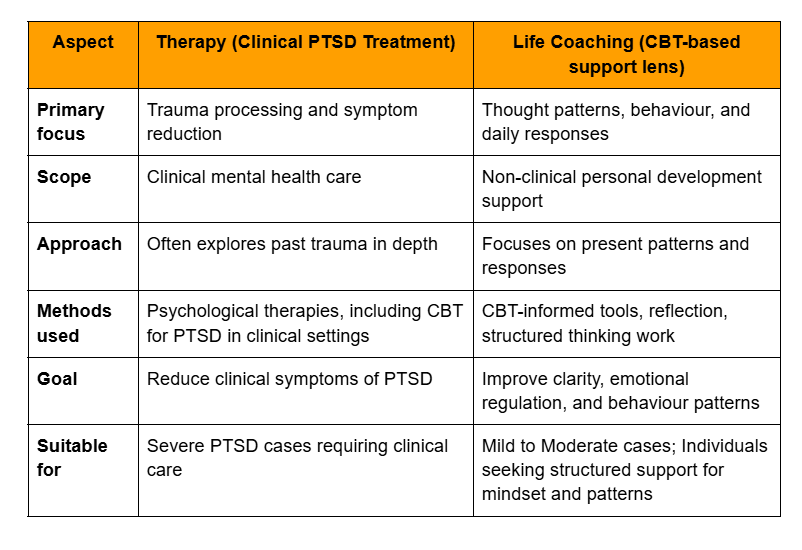
PTSD recovery often involves different types of support, but therapy and CBT-based life coaching serve different roles. Both can be part of a recovery journey, yet they do not work in the same way or focus on the same depth of trauma processing. Understanding this difference matters when looking at PTSD treatment, emotional recovery, and long-term stability.
Read Next: Certified Life Coach vs. Therapist: What's Right for You?
How Reclaim Happy Supports Emotional Healing and Personal Growth After Trauma
Trauma changes how thoughts, emotions, and reactions work in everyday life. Many people notice persistent patterns such as overthinking, emotional overwhelm, avoidance, or sudden shifts in mood that feel difficult to control or explain. These responses often continue even when the original situation is no longer present.
At Reclaim Happy, the focus stays on CBT-powered life coaching. The work is grounded in Cognitive Behavioral Therapy for PTSD principles, where attention is placed on how thoughts influence emotional reactions and behavioral responses in real time. This approach focuses on present patterns rather than revisiting past events.
Our motive is to bring clarity to what is happening internally and how those patterns shape daily functioning. Many individuals experiencing PTSD symptoms notice cycles that repeat under stress, especially in thinking and emotional responses.
Core areas of focus at Reclaim Happy include:
- Thought loops: Repetitive thinking patterns that intensify distress and reduce emotional clarity
- Trigger reactions: Immediate emotional responses linked to past experiences or perceived threat
- Avoidance patterns: Withdrawing from situations that feel emotionally demanding or uncertain
- Emotional regulation difficulty: Struggling to return to a stable state after stress or activation
- Guilt-based thinking: Carrying responsibility or self-blame beyond what situations require
CBT-based work at Reclaim Happy focuses on recognizing these patterns as they happen and understanding how they maintain emotional strain over time. This process stays centered on current experience and behavioral response, not trauma processing.
Our forward-thinking approach is part of the broader techniques of CBT for PTSD and reflects how PTSD treatment can include present-focused cognitive and behavioral work to improve daily emotional stability.
Book a free consultation to understand your patterns and begin healing with empathetic, intelligent support from Reclaim Happy.
FAQs
What is PTSD and what are its common symptoms?
PTSD is a trauma-related condition where the mind and body stay in a heightened stress response after distressing events. Common PTSD symptoms and treatment concerns include intrusive memories, avoidance, emotional numbness, sleep disturbance, and feeling constantly on edge.
How does Cognitive Behavioral Therapy (CBT) help with PTSD?
CBT works with the link between thoughts, emotions, and behaviors. In CBT for PTSD, the focus stays on identifying thought patterns that trigger fear, avoidance, or emotional distress, then working with those patterns to regain emotional balance.
Is CBT considered an effective treatment for PTSD recovery?
Yes. PTSD therapy often includes CBT as one of the methodical approaches used for symptom management and thought-pattern work. It is widely used within PTSD treatment plans that focus on cognitive and behavioral responses.
Can life coaching help someone recovering from PTSD?
CBT-based life coaching focuses on present-day thinking patterns and behavioral responses. It is used for individuals who want structured support with emotional regulation and daily functioning within PTSD recovery treatment options.
What is the difference between therapy and life coaching for trauma recovery?
Therapy focuses on clinical diagnosis and trauma processing. Life coaching at Reclaim Happy focuses on present thought patterns, emotional responses, and behavioral cycles. Both differ in scope and structure within trauma recovery support.
What are the best treatment options available for PTSD?
The best treatment options for PTSD depend on individual needs. Common approaches include clinical PTSD therapy, DBT & CBT-based interventions, and emotional support focused on symptoms and daily functioning.
How long does PTSD recovery usually take?
There is no fixed timeline for recovery. Progress depends on symptom severity, support systems, and consistency of PTSD treatment. Each person experiences change at a different pace.
Can PTSD symptoms improve without professional support?
Some people notice partial improvement over time, but expert-led PTSD treatment is often needed when patterns persist or affect daily life significantly.
When should someone seek professional help for PTSD?
Support should be considered when symptoms affect sleep, relationships, emotional stability, or daily functioning. Early PTSD therapy or CBT-based support can help reduce long-term impact.